The Matsuda Sangyo Group is committed to fulfilling its social responsibility in the core areas of legal compliance, fair trade, environment, quality control and stable supply, human rights, and information security, with a view to bringing about the realization of a sustainable environment and society. At the same time, we will work on ensuring responsible procurement by building relationships of trust with our procurement partners, positioning coexistence and mutual prosperity as our foundation, and continuously promoting social responsibility across the entire supply chain.
In March 2023, we enacted the Matsuda Sangyo Group Supplier Guidelines based on the RBA* Code of Conduct, which set out international standards that serve as a guideline for responsible procurement activities, primarily for the electronics industry. These Guidelines were revised on April 1, 2025, to reflect changes made accompanying revisions to the RBA Code of Conduct.
The Code of Conduct prescribed by the RBA is based on internationally recognized standards such as the OECD Guidelines for Multinational Enterprises on Responsible Business Conduct, the UN Guiding Principles on Business and Human Rights, the ILO Declaration on Fundamental Principles and Rights at Work, the fundamental conventions of the ILO, and the UN Universal Declaration of Human Rights. It also serves as a standard for ensuring that the working environment in the supply chain is safe, and that business is conducted ethically and with respect for human rights and the environment. As such, we encourage our procurement partners to understand and comply with the Matsuda Sangyo Group Supplier Guidelines, which conform with RBA’s Code of Conduct, with the aim of realizing a sustainable environment and society through the creation of a better workplace environment across the entire supply chain.
*RBA: The Responsible Business Alliance (RBA) is a corporate federation whose purpose is to promote social responsibility in global supply chains, and it aims to improve corporate social responsibility (CSR).
Through the publication of the Matsuda Sangyo Group Supplier Guidelines and other initiatives, we ask for the understanding and cooperation of our business partners, and at the same time, work on building supplier engagement with our key business partners to strengthen relationships and achieve coexistence and mutual prosperity
We classified business partners that provide products (including materials made with precious metals) and services to Matsuda Sangyo Group into supplier categories based on the nature of the transactions, and carried out screening of suppliers based on our unique selection criteria (scale of transaction, certification by RBA, etc.) from the perspectives of comprehensiveness and importance. We then identified and selected key primary suppliers as the targets for supplier engagement.
|
Suppliers of direct materials |
Top-tier customers and business partners that make up 80% of Matsuda Sangyo Group’s (in Japan) transactional amount(as Matsuda Sangyo is in the recycling business, customers are also included). |
|
Suppliers of indirect materials |
On-site resident vendors On-site work contractors |
|
Temporary staffing and recruitment agencies |
|
|
Supplier of main components and materials |
|
|
Industrial waste processing company |
In engaging suppliers, Matsuda Sangyo places priority on the Precious Metals Business Segment, which is engaged in the provision of products and services.
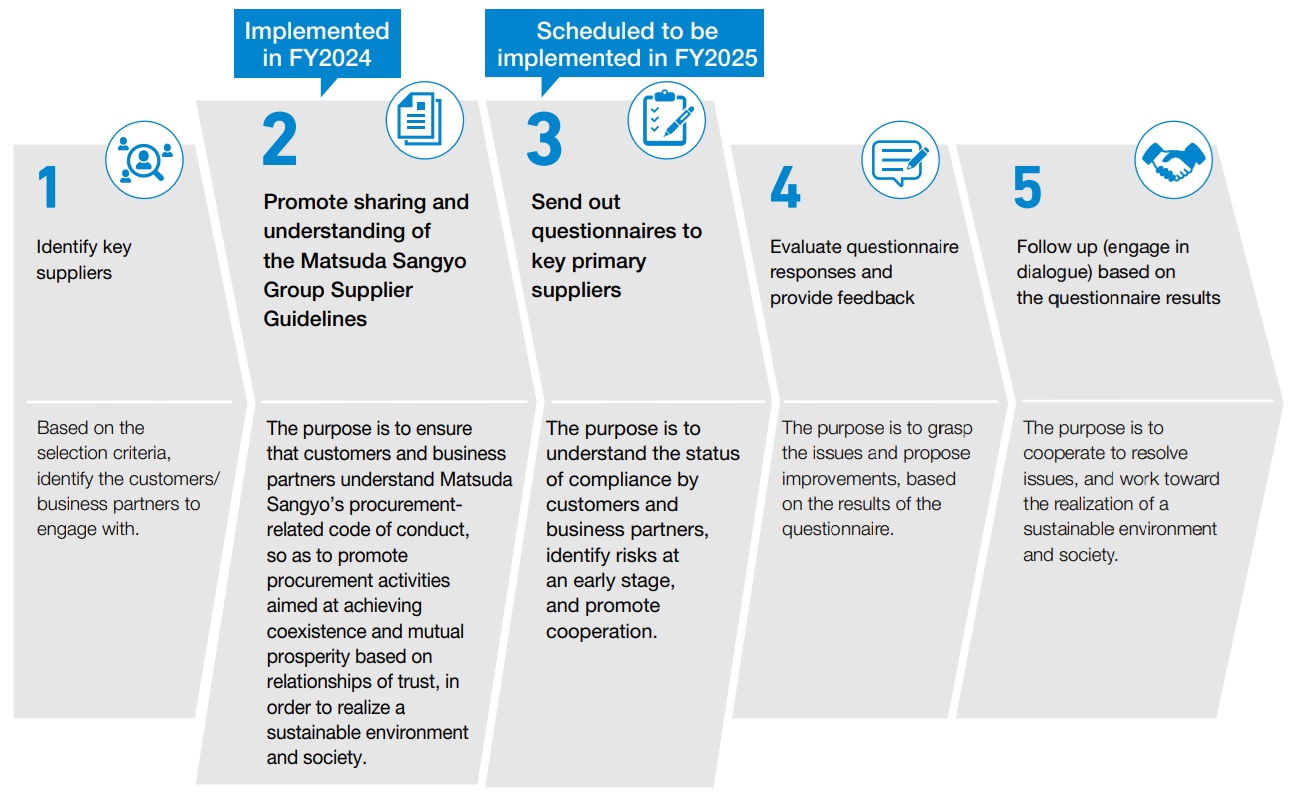
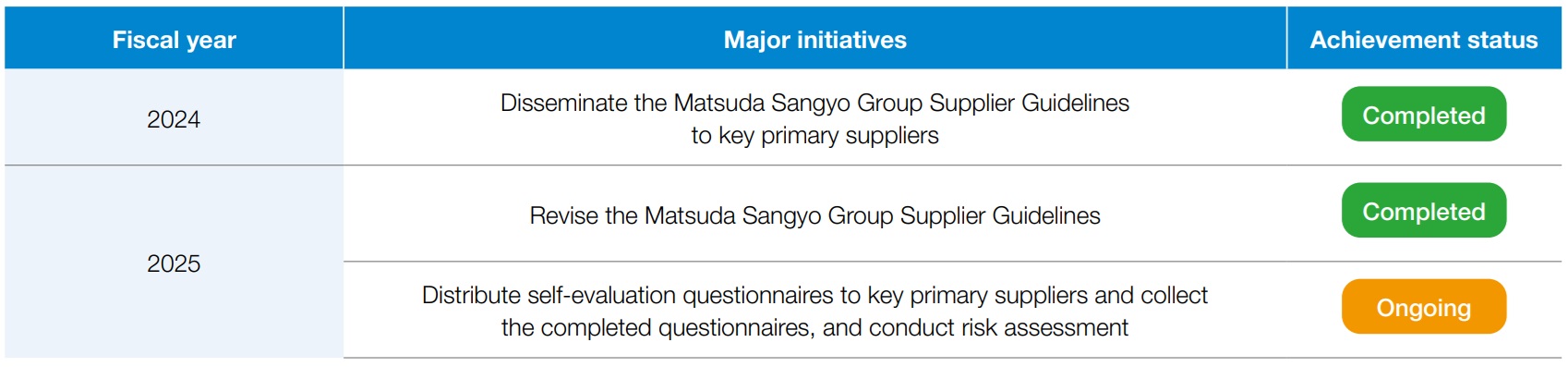
In FY2024, we disseminated the Matsuda Sangyo Group Supplier Guidelines (1st edition) to 256 key primary domestic suppliers of the Precious Metals Business Segment and requested submission of a confirmation form to verify their understanding of the Guidelines, to which we received a response rate of 87%.
In FY2025, we plan to disseminate the Matsuda Sangyo Group Supplier Guidelines (2nd edition), with contents revised to align with the RBA Code of Conduct, and request submission of a letter of consent. By asking our suppliers to conduct activities in accordance with the Guidelines and promptly report any deviations, we aim to enhance understanding of the status within the respective companies, enable early identification of risks in the supply chain alongside the corresponding response, and promote cooperation with our business partners.
Going forward, we will further strengthen our cooperative framework by deepening mutual trust with our suppliers as we seek their understanding toward the spirit of the Matsuda Sangyo Group Supplier Guidelines and our initiatives. We will work on building partnerships toward realizing a sustainable supply chain based on shared values.